Showing posts with label The Gentleman. Show all posts

Friday, July 18, 2014

Seven Quick Takes: Take-Noko!


--- 1 ---
Urban Exploration Phototime
The fact that I'm doing a link-up of any sort pretty well tells you I'm not very good at coming up with ideas on the fly anymore. Truth be told I spent most of my mental energy on retaining a number of things I promised myself (and have been told by wiser folk than I) not to hold on to anymore. While I'm pleased to learn my memory is much more voluminous than I give it credit for, I'd really rather use it for other things. I suppose the only thing for that would be to finally offload some of the memory-kruft into other formats. Speaking as someone equipped with a reasonably broad pallet of paper-based and digital storage media, you'd think I'd be able to get a handle on all this junk... but no, not so much.

--- 2 ---
Over a year ago now, I had a particularly bad week at the old Pet Store, where i used to work at the time, as many of you will remember. There was a spree of bad luck involving a number of digital devices - my phone and my iPod Classic among them. Screens were broken, nasty words spoken to nobody in particular, and the up and down of it is that I wound up with no real motivation to replace them.

It wasn't that I wasn't replacing broken things. I have replaced, since then, several pairs of headphones (including a very expensive computer headset I use for doing audio-video work and gaming, the five minutes a week I have to myself). But the thing is, I have always been bad with my electronics, since I was very young. I suppose a factor in that might have been my generation (I had a freakin' palm pilot in 1999. When I would have been in the fourth or fifth grade. That's messed up), but the factors don't mitigate the problem.

I figured if I could go a year, limping along with equipment that was in less-than-perfect condition, I could make do. The iPod was a relatively easy fix - set single playlists of a manageable length and change them out when they get boring. The phone itself was a non-issue. I can't always see the screen as well, but the touch functionalities still worked fine, and I could still bank, hammer out a text message, or dial as I saw fit. It wasn't until recently, when dust and moisture started being able to get their way into the phone, that the broken glass really became an issue. If it wasn't for that, honestly I would have waited another year, until my contract expires and I can get a new phone at reduced cost.

Now, I'll probably do an early upgrade - renewing my contract on new terms - or buy a used phone of a similar model. The iPod itself as simply stopped working altogether. The four or five days I went without it were so torturous that I'm borrowing a spare one of The Lady's until I can replace it, or at least ween myself off of having total audio control.

--- 3 ---
Fredericton, where I now live and have for several months, was recently struck by the tail-end of Tropical Storm Arthur. This is not an unusual occurence in this part of Canada, and in fact, living closer to the ocean as I used to, I became rather used to the odd bit of high winds and heavy rains that such storms represented. That's why I was surprised to not only lose power on the day of the storm (a Saturday), but to not get it back until Tuesday of the following week. While I freely admit that nothing in my fridge was quite so "correct" as I would have liked it to be, the loss of a few pounds of salmon, half a pork tenderline, a bit of leftover roast duck, and all told about another $80 worth of condiments, long-storage dairy, and other munchables was sort of an unexpected kick in the gut.

The part of the storm I can't stop laughing about, though: Literally two nights before, I threw out my best-and-only piezoelectric flashlight because some impact or another had cracked the casing in a way that rendered it inoperable. They say it never rains...

--- 4 ---
Beautiful work patio often leads to late nights after-hours.
I just can't get enough of this new game I've been playing. It's supremely irritating when my brain does this sort of thing, in some ways, though there is a great and satisfying itch in the childlike enthusiasm for the latest whateverthehell has my attention now.

I suppose in large part I have been overly luxurious. I was rather showered in books at my birthday, but the lucky chance of cheaply acquiring the recent Bravely Default (Nintendo 3DS by SquareEnix) was surprisingly welcome. The game is very good and I recommend it to fans of classic RPGs. It turns away from Square's millenial fascination with ATB-style systems to take a trip down memory lane to turn-based, but also includes some interesting new features to take advantage of the 3DS's sleep mode, passive wireless functionality, and Augmented Reality architecture. Very good title.

--- 5 ---
In one of those never-say-never moments, I've learned I actually have some level of skill in pastries - just so long as no actual pastry is involved. My day-to-day work, until very recently, was entirely concerned in the perparation of small, bite-sized desserts. Vault 29 has me, after consulting with a few highly-qualified chefs, making their desserts-in-miniature. So I've acquired some real chops when it comes to no-bake cheesecake, fresh lemon curd, vegan desserts, chocolate mousse, panna cotta, and, of late, Key Lime Pie.

It's almost a shame that I won't be doing pastries much longer, though I never really intended to be a pastry cook forever. Still, having a section of my own to run independently and with a minimum of supervision, and rather a lot of lattitude as far as creative control, has been really, really good for the ol' mental health.

--- 6 ---
I've taken to eating breakfast again! Neat trick - if you eat breakfasts that are good cold, there's absolutely no reason not to make it the day before. Lately: Lemon Greek-Style Yogurt, Grapefruit, mini-doughnut and water.

Also, gigantic fan of random beverages - today I had the juices from a somewhat-too-juicy berry compote cut with soda water.

--- 7 ---
Apart from bravely default - of which I've played about an hour this week, I really haven't had much time for any other gaming. Any other free time has been eaten with plans for a big move that's upcoming, or recouperating from being alive with beer and books.

Lately: The Lord of the Rings, and a lovely little HP Lovecraft anthology.

For more Quick Takes, visit Conversion Diary!

Wednesday, April 16, 2014

The Last of the Nutrition - Vitamins, Minerals, Antioxidants, and Living Critters!

So until now and apart from the brief mention of ethanol and caffine, I've been pretty good about not mentioning drugs. However, since someone did ask about it, I might or might not do a secondary series on the topic. As it happens though, drugs aren't nutrients. They affect the operation of the human biochemical machine but they don't really count.

Having said that, we have a lot to talk about this time around, because the "other" category of nutrition is actually pretty complex. As you might imagine the body uses a ton of different elements in its construction and you can't just take in pure forms of the elements (generally) in order to achieve growth and function.

The first thing we have to talk about is vitamins. There are, if I remember correctly, 13 vitamins. These aren't 13 individual chemicals but actually 13 categories into which chemicals called vitamers are sorted depending on biological activity. 4 of the vitamins are soluble in fat which is one of the reasons why a fat-free diet won't work and the other 9 are soluble in water which is why we have to consume so much of it.

As something of an aside, you are basically hydrated if your urine is very pale or clear. The usual rules of thumb for how many glasses of water a day to drink vary as widely as how many calories a day to consume and so I will refrain from posting any guidelines apart from that metric.

Now, your 13 vitamins are A, B1, B2, B3, B6, B7, B9, B12, C, D, E and K. For each vitamin there is a maximum and minimum daily intake guideline, an associated underdose and overdose syndrome, and different food sources. As a general rule unless you are otherwise unhealthy or for some reason cannot physically eat enough food to obtain each of the vitamins or for some strange reason do not have access or are allergic to whole categories of foods you should not need to supplement your vitamin intake. As a matter of fact, Vitamin D can by synthesized by your body under UVB exposure.

The different vitamins all have different effects on the body and prioritizing them, say, to achieve a particular effect over what you would achieve by consuming merely the daily requirement may be one vector by which you can tune your diet to tune your body. For example, I tend to supplement vitamin E in winter and take more foods with vitamin E in the rest of the seasons because it plays a role in regulating mood, and there is a seasonal component to my otherwise regular up-down cycle of biploarity.

In addition to some vitamins being soluble in fat and some being soluble in water, all of the vitamins are affected by cooking and different vitamins respond to different cooking methods in different ways. A fantastic table of these effects is found on wikipedia, but there's a few general rules of thumb: losses are greater for boiling than steaming and with the exception of B2 vitamins are more available to the body in the raw food than after cooking.

Having said that, this isn't an argument that all diets should be raw food diets any more than my personal preference in tuna preparation is that all tuna dishes should be nigirizushi.

Rocking On

After your vitamins come your minerals, which can be divided into two categories based basically upon bodily need, your macrominerals and your trace elements. For the vast majority of these elements, your body really wants the ions. Fortunately, ionization happens readily in aqueous solution and your body is 70% water for the ions to be dissolved into so we've got that part covered. Excess minerals are among the excreted substances in urine which a humorous person could suppose would allow you to call your urinary tract an ion cannon but I personally think we're above bathroom humour here.

Your macrominerals are: calcium (important for bone health), Chlorine (more specifically, chloride ions), Magnesium (which is particular important as Magnesium is a key component of ATP which is the chemical that transfers energy around your body); Phosphorous (in ATP, DNA, and Bones); Potassium (regulating electrolyte balance), Sodium (which your body needs because it is used in muscle control which is kind of important for things like having a heart-rate and, you know, doing things); and Sulfur, which is a component of pretty much all of the amino acids both essential and otherwise.

Now, you can overconsume the macro-minerals and sodium over-consumption is particularly problematic which is why it's one of those nasty words and why you're seeing so many processed foods bragging about low sodium content. If you're otherwise healthy, however, there's no good reason to remove it from your diet completely, but you may want to stay below about 2.5 grams per day which is quite a bit more than you need but still below the range where it causes hypertension.

After that come the trace elements which are all essential, mostly because your body can't produce elements from lighter elements - as cool as your body is, it doesn't really work with nuclear chemistry that often. We need cobalt, copper, chromium, iodine, iron, manganese, molybendum, selenium, zinc, and maybe vanadium (we haven't decided that one yet).

Now, of those I would suggest that they are all important but particularly iodine (which most people only obtain through iodized table salt now that we aren't so big on the organ meats) as it prevents glandular dysfunctions, iron as it moves oxygen around the body, chromium which allows your body to process sugars, and manganese which lets your body actually do things with the oxygen its moving around are the most important, but again, you need all of them. Trace minerals are the ones most often low on the diet so I strongly recommend investigating your consumption and then supplementing the ones you're lacking if necessary.

That's All, Right?

Well, no, not really. There are some other dietary components that aren't as established in the zeitgeist but nonetheless are becoming increasingly important in our understanding of human nutrition.

Antioxidants which either prevent the formation of free radicals during metabolism or absorb them all up (thereby preventing cell damage) are becoming increasingly popular in recent years. I've spoken about them before here in my tea reviews and while I don't pay the most attention to them I've learned that they have been clinically demonstrated to have some good health effects, though clinical trials have shown them to be minor and that over-supplementation can be harmful. Your body can actually produce quite a few of these compounds on its own with enough the the precursors Glutathione and Vitamin C. There are thousands of different antioxidant compounds of dietary relevance and tracking your consumption is largely impossible based just on that complexity, but it should be noted that variety in foods that are rich in antioxidants like colourful fruits and vegetables is better than an antioxidant pill.

One subgroup of about 4,000 antioxidants are the phytochemicals (like the polyphenols) which are, like antioxidants in general, sufficiently complicated that no one phytochemical can be said to be preferred by the body over any other. In point of fact there's some evidence to suggest that useful phytochemical intake comes only from diet and that supplementation is essential a waste of money with zero clinical benefit. Antioxidants and Phytochemicals are the bleeding edge of nutritional science and we really don't know much about it but this is where the developments will be coming from.

The last thing I want to talk about is the stuff that is living inside of you. Believe it or not not everything we eat is dead and nor should it be. Your GI tract in particular is practically a nation of different species of organisms from Lactobaccilicus to E coli, all of which are necessary for a happy, healthy you. The exact species and proportions are being studied and do vary according to age, but there are circumstances in which getting more - by eating live-culture foods like yogurt or by supplementation - is advisable, such as after courses of antibiotics. Dietary Fiber also plays a role in the health of your gut flora which then goes on to regulate certain other aspects of your life such as how much of your time you waste playing angry birds on your phone in the john.

For the record, I hate angry birds.

Gut Flora, as it's called, performs a number of functions for you. Complex carbohydrates are broken down into more managable forms by fermentation, which reduces the amount of food you have to eat to reach a caloric break-even point and also produces that other uncomfrotable waste produce - flatulence.

There's some evidence that some of the species of Gut Flora, which use your GI Tract's mucus lining as their growth substrate, actively protect that lining and even prevent certain forms of injury to that lining from forming, which would otherwise be very painful.

Furthermore, because your body has a colony of bacteria already inside of it that's eating up all the things bacteria like to eat up, the gut flora have a competative advantage over pathogenic bacteria that would otherwise make you sick. This is not unlike the way that a well-planted fish tank is less susceptible to algae blooms, in fact, it works on the very same mechanism. In fact, maintaining a healthy internal ecosystem can be so useful that it can even prevent or help to control irritable bowel syndrome.

So while, yes, some strains and species of bacteria are harmful to you, so are some varieties of virtually everything else. If anything over the last few weeks we've learned that there are no good foods or bad foods, only better foods and worse foods. Even the worse foods aren't really verboten. Your body doesn't actually acknowledge the human compartmentalization of time and even circadian patterns of sleep and eating are mutable as we're going to see in a few posts when I talk about polyphasic sleep. While large swings in nutrition are ill-advisable as anyone whose gone from one type of diet to another can probably tell you, diversions from your diet on occasion won't actually hurt you as badly as some people believe, and on a psychological level would probably do you some good.

I mean, of the four major human experiences - death, food, sex and other humans, only death is more ubiquitous than eating. By our very nature we are obsessed with and concerned with only eating enough not only to survive but to reproduce. And while I can and others have survived very well on diets made entirely of single-flavour elements such as the Great American Meat and Potatoes paradigm or the relatively new Soylent Smoothie synthetic diet, the happiest people I know are all the ones who eat the most differently. The human brain is, after all, thirsty for experience, and whether we crave variety in having scalloped potatos this week instead of mashed or always having some kind of cake for dessert on sunday dinner or it's bouncing from sushi to pasta to brioche to burgers to salads over the run of a weekend, variety is the cliched seasoning of life and, what's more, we've just seen that there's nutritional benefits to it as well.

Monday, April 15, 2013

Digesting the Boston Marathon

So, as you might expect, where I've spent  the better part of the afternoon tuned into WHDH Boston (local channel 7, general purpose NBC affiliate), I've spent the afternoon, the evening, and now an hour or two of the night thinking about, hearing about, reading about, and generally trying to cope with the idea that sporting events are fair game now. I still haven't cut that umbilical, and I probably won't until I collapse into sleep the way I usually do.

In that time, we've gone from eight bombs to three, twenty victims to a hundred, and I've heard every conspiracy from false-flag attacks (which someone asked the relevant governor about directly) to foreign participation.

As a correction, the bomb at the JFK Library turned out to be a completely unrelated mechanical fire.

What I can say, is that I am proud of humanity at this moment in time. I was proud to see absolutely everyone on screen at the time of the blast stop, turn, and run into the smoke to immediately help however I can. I've heard reports from on-the-scene journalists of encountering bloody people with a focused look, asking them if they needed help, and that person simply saying "I'm a doctor" as they carry on their way.

At this moment, when we know nothing, when we have nothing specific to fear, rather than fearing everything... I choose to have faith.

Monday, March 25, 2013

Transgender Identity

Warning: This post deals matter-of-factly with matters regarding sex, sexual intercourse, and human anatomy. If you are immature with regards to these matters, consult your parents before continuing.

On Wednesday, a private member's bill had its third reading in the House of Commons and passed the house with an 12-vote margin - and the votes of 18 Conservatives including four cabinet ministers. The prime minister, quite naturally, opposed it, along with most the rest of his party. The bill, C-279, is An Act to Amend the Canadian Human Rights Act and the Criminal Code, with regard to the issue of Gender Identity. The full text is available through the link.

Christian, Buddhist, or somewhere in between, I think we can all agree that the greatest part about living in Canada is that our nation has a constitution that defends the right to free expression of religion. That means, among other things, that there's no real reason to go into any sort of religious dialogue when discussing human rights. The right to religion is already protected and nothing the government does can change your religious identity. For that reason, I'm going to avoid wading hip-deep into the theological implications of transgender politics and stick to the political side of things.

The English-Speaking world has conflated Sex and Gender for hundreds and hundreds of years. I happen to know that my employers don't distinguish between the difference and get very annoyed when you do. This is something that's so easy to understand, all you need is a concept of the mind and the body being separate - you need to have been alive for about a year, in other words.

Sex, strictly speaking, refers to the biological male-or-female-ness of an organism - the possession of the appropriate genetalia to perform the functions of the sexual act as is proper for that gender. In mammalian animal species, such as Humans, Cisgendered males have penises which are used to inject semen into the vagina, cisgendered females have vaginas with which to collect semen and wombs with which to bring forth offspring.

Gender is more psychological, and sociological studies suggest it's not the intuitive binary male-or-female we have come to expect. In an overwhelming majority of cases, those with male sexual organs exhibit gender identity closer to the masculine end of the spectrum and those with female sexual identity tend toward the feminine end of the spectrum. This is why the two terms are conflated, and it's also why we have terms like "butch", "sissy", "fruity", and so forth to describe individuals who stray too close to the middle, or opposite end, of the spectrum. It's also why terms like that are derogatory - humanity's social structure has, for hundreds of thousands of years, essentially reinforced the idea that homogeneity is good. Regardless of where you sit on the spectrum, if you think of your gender as being your sex, you're "cisgendered" and properly-aligned, and feel no need to change anything.

The root of the issue involved in trans identity comes in this way - some men and women tend so far toward the opposite ends of the gender spectrum that they identify as being a part of that end, regardless of their sexual identity. This is known as being Transgendered, and this is why some medical instutions began to develop increasingly sophisticated sex change operations - though undergoing such surgery is not always desired and, indeed, not a pre-requisite for being transgender. If you're curious as to the actual mechanics of being transgendered, ask a transgendered person you know, or use The Google.

In practice, this bill changes very little. Printed out in full and in both languages it is six pages long, with quite a bit of that being wasted white paper. All it does is establish legal definitions of the problem of gender identity, and establish both cisgendered and transgendered individuals as protected classes against discrimination and hate crimes.

It doesn't make it easier or harder to chemically or surgically transition from one sex to the next;
It doesn't spontaneously allow alterations to even civil marriage codes;
It doesn't infringe upon your right to religious freedom, regardless of how you feel your religion has informed your opinions on transgender identity.

The bill is up for its second reading before the Senate today. This would be a good time to establish a connection of some sort with your Senator and ask them to support Bill C-279.

Thursday, March 21, 2013

Prejudging, Judging, and Divine Directives

Earl Grey White Tea
As I sat alone this morning in the basement of my boss's house, drinking what's probably the last of the Phoenix Mountain Dan Cong, I came to the sudden, sharp realization of a few things all at once.

Firstly, that earthenware retains flavours, and all my teas are now likely to taste salty for several days after having only just once made OXO-brand fake chicken stock in it to serve as a between-meals savoury-thing to keep my tongue happy.

Secondly, and no more relevantly, that I should stop thinking of a 10:30 wakeup as being lazy when it gets me up four hours before I have to leave for work.

Thirdly, and more to the point, that we, as a society, judge personal worth based on some properly stupid metrics.

We've all had that friend, I think, with the heavy eyelids and the full-arm tattoos that gets most passers-by assuming he's a drug user without having ever met or interacted with them. Once that assumption is made, even subconsciously, other traits begin to get applied: shiftless, under-achieving, possibly unemployed, probably unemployable, and so forth.

As an experiment, an aquaintance of mine from high-school who actually does fit that description shaved his head to eliminate the somewhat skinhead-esque haircut he'd had, bought himself a nice Denver Heyes dress shirt thick enough to hide the tattoos, had me update his resume for him, and tried to get back into the workforce. What people saw instead was someone industrious, a go-getter who was a great catch in a labour market currently swollen with terrible applicants for even the most menial positions. He was offered all three jobs he was interviewed for. God willing, he might even live up to these expectations.

Now, take it from me - I'm the straightest-edged guy you'd think you ever saw, and I've got as many twists and turns in me as any other piece of poor white trash you happen to come across, in spite of being neither. Physical appearance is nigh-onto-worthless in evaluating a person's job performance.

Let's consider the example of another friend I have. He has a single tattoo on his forearm - an ambigram of his sign in the western zodiac with his birth date beneath it. This guy is one of the harder-working, more level-headed and agreeable people I know, and anyone who actually takes the time to interview him comes to pretty much the same conclusion.

When his recent employers learned of the tattoo, they altered the uniform for him, and him alone, to hide it. I suppose that's better than firing him - I've heard of people fired for such things - but at the same time, in the role he performs in the industry in which he's working, a forearm tattoo is about as off-putting and relevant as green eyes.

On the tattoo thing, we're a society that's pretty much embraced the technology and its application for a good two, maybe even three, generations now, but we're pretty much pandering to those above us.

Moving on to the broader topic at hand (I, being uninked, couldn't possibly care less about Tattoos) we really do judge personal worth on pretty stupid metrics. More importantly, it's pretty surprising we bother to judge personal worth at all.

This is how a boring person looks
Now, as it happens, I don't like reaching for the bible to support my arguments if I'm not expressly discussing theology - I find even morality can usually be arrived at directly without divine intervention thanks to having been raised in a society that values, by and large, the Golden Rule.

There is however, Matthew 7:1-6:

1 Judge not, that ye be not judged.
2 For with what judgment ye judge, ye shall be judged: and with what measure ye mete, it shall be measured to you again. Mk. 4.24 
3 And why beholdest thou the mote that is in thy brother's eye, but considerest not the beam that is in thine own eye?
4 Or how wilt thou say to thy brother, Let me pull out the mote out of thine eye; and, behold, a beam is in thine own eye?
5 Thou hypocrite, first cast out the beam out of thine own eye; and then shalt thou see clearly to cast out the mote out of thy brother's eye.
6 ¶ Give not that which is holy unto the dogs, neither cast ye your pearls before swine, lest they trample them under their feet, and turn again and rend you.

To me, a strict interpretation of this passage seems to indicate we have no business judging people at all, and my secular values agree with me. The only relevant judgments are judgement on the matter at hand. Tattoos at a job interview are not relevant, even in the service industry, unless they are somehow indemnifying on their own merit (racist, ideological, and so forth). They are no more material to the dispensation of your duties than the colour of your hair or eyes. The real metric of relevance is past and present job performance, personal charisma in the interview process, and, frankly, demonstrable creative energy and drive. Anyone who can spin the Hilton into work afterward the way I did probably deserves the job they got - a shame that job fell through.

Thursday, March 14, 2013

First Thoughts on the Holy Father

So, last night, well ahead of my anticipated date for such an election (I was gambling on late tomorrow afternoon), the Cardinal electors settled on one of their own an elected Jorge Cardinal Bergoglio, Archbishop of Buenos Ares, who took the name Francis (the first pope to ever name himself after my favourite saint, Saint Francis of Assisi). He is also, as I understand it, the first Jesuit priest to ever be named pope.

While that's sinking in, you'll understand we don't have a lot to go on on how a Jesuit or a devotee of Saint Francis behaves when they have the papacy. It's been less than 24 hours since he was named, and now we have some pondering to do.

So far, everything about this man screams humility, except, perhaps, for the brocaded sash and french cuffs that he wears. When coming forward for the usual welcomings and so-forth, he decided to forgo the bright crimson and gold of some of the other papal garments. He opted against the usual papal motorcade and went personally to the hotel he had been staying at previously to collect his bags, also shunning the same special sedan to travel on a bus with the cardinals and refusing a raised dias from which to address them.

In short, less than a day in, so far this pope is everything I could hope for a pope to be.

What's more, if he keeps it up, we could see real change in the way the papacy operates - Pope Francis, as Cardinal, had a notedly simple lifestyle even for local cardinals. If he continued that trend into the Papacy, it would be difficult for his successor to bring back all the usual luxuries of the papacy.

In short, if he pursued his simplicity doggedly, he could fix literally everything the public sees wrong with the Church... at least, everything that's not a matter of Doctrine. I don't foresee women as priests, a change in sexual morality, or the sudden suspension of the seal of the confessional in molestation cases on the horizon.

Have I talked about that before? I might have. I honestly can't remember.

At any rate, he could fix everything I see as being actually wrong with the church to which I am, I suppose, still a member, if not a lapsed one. I have doctrinal concerns - so does everyone my age, I think - but what would do me most good to see would be someone bringing a little Franciscan humility to the papacy, and maybe taking the gilded edge off just a tad.

Monday, February 25, 2013

Could that be Private (or Lieutenant) Auditor?

These days, I tend to look less like this...
So, I make no secret about a time when I used to be a Royal Canadian Army Cadet (rank of Master Bombadier - we were an artillery corps), and I make less of a secret about the way in which I semi-frequently consider joining the actual military as a Cadet Instructor Cadre member.

The thing that holds me back is actually that I never "aged out" as a cadet, but rather quit. Ostensibly, I did it to free up time - I usually say for schoolwork but anyone who knows my history and has seen my transcript would realize pretty quickly that I did it for the girl.

Because that quitting was preceded with shuffling from service branch to service branch trying to find something that was more freshly appealing, and because I've never managed to hold a job or go without an outburst of some kind for as long as our tours of duty last up here, I've hesitated.

If it was the CIC I joined, I'd only need to do a few weeks of training, and then I'd be moving on into a life of even less military activity than a reservist. And that has appeal. The cadet movement is a valuable social program and I wish I'd had greater participation in it as a kid, now that I've got no real social hangups and could have used the discipline and, let's be fair, prestige that comes with having served as an army cadet for the better part of a decade (cadets are allowed to be between the ages of 12 and 18).

And more like this scrub.
Just as often, I think about joining the actual military. The branch of service varies from time to time - I'm disqualified as a military pilot, but a life as ground crew in the Air Force interest me, as does the occasional stint in the Navy, which anyone who has seen me near water, read or written psychiatric reports, or had to spend a weekend with me will all pretty much agree is a terrible idea.

Having said all that, I used to set aside my ridiculousness to go to Summer Training Centres like Argonaut ACSTC. There was usually money involved when it came to that, though.

In the end, it's a wash, and I should really be packing instead of thinking.

If anyone's wondering what brought this on -  this article by Cam over at A Woman's Place seems relevant, if only tangentially. That's just how my brain works.

Thursday, February 14, 2013

A Tale of Blockages

The original caption here was "contrary to my whining,
I really do love my job". Simone Ritter Photograph
Surprisingly, some people believe me to be an artist. I don't consider what I do to be an art - mostly because my experiences with the word lead me to believe that if I finally give up and admit any of my pursuits to be artistic, they'll become for me what cooking is - a place to go and frustratedly masturbate about my own creativity while ignoring the fact that I've never contributed in any important way to a field.

I write this, fittingly enough, in the loft studio of one of my province's most prestigious art schools.

Tying anything to arts, for me, is a curse. I called cooking an art, and now I can only cook to any satisfactory degree while I'm manic enough to give it energy equivalent to my ordinary undivided attention. Naming something an art makes it a time-sink, where the smallest flaws are ruination, and the best strides forward are "not noteworthy at all".

After all, once I've created it, it's not really creative anymore, is it? No idea's original once it's put down, and nothing hasn't already been put down at once. Every now and then, something truly creative comes along. A few years ago, Chef Homaro Cantu of MOTO in Chicago, Illinois created a method of creating "sushi" whereby the ingredients typical of makizushi (zushi rice, toppings, seasonings, and nori) are blended to a forcemeat-like consistency  and rolled in rice paper, printed with images of full platters of traditional zushi, chilled to set, and then cut as makizushi traditionally is. Lots of people - purists, really, myself included - gave him flack for it.

See, this style of modern creativity in cooking has fallen under the catagory of what a lot of people call "molecular gastronomy". I have fun with it now - doing weird things like my now infamous Liquid Nitrogen Sorbets. Mostly, though, I steer toward the classics. For all my love of all things Science and Tech, my tastes in the arts - all the arts - is usually surprisingly conservative.

It doesn't make it any better that my two chosen art-forms at the moment seem to be writing and videography - not that I consider anything I do in either regard to be the least bit artistic. How do I innovate in filming when I film with a smart phone?

How do you innovate in writing at all, except through bleeding-edge poetic experimentation that nobody would understand?

Ultimately, this post didn't go where it was supposed to at all. This was supposed to be an apology, for low activity rates and sub-standard posts. I was going to go on and on about other commitments. But right now, I'm sitting in the loft studio of one of New Brunswick's best art schools, drinking locally-roasted coffee in my peanut butter mocha, which was topped with a home-made marshmallow, daydreaming about the menu for the dinner I'm going to later tonight, and thinking about just how much of my soul I'd really have to sell to get back into the art that fuels me.

There was a time, I remember, when my knives were an extension of my arm, when my heart was a machine for pumping fire through my veins, and when I actually had a medium I was capable of comprehending. That was a long time ago, but there's a saying about horses that seems relevant.

Sunday, January 20, 2013

Time to Digest

I can't not look creepy in a photo.
So, something I never used to do was stay seated after I ate. Whether it was at home or eating out, I usually ate the slowest in the group, or had something more important to go off and do (or so I usually considered it). It wasn't really until I met my better half that I developed the habit of sitting down to digest a meal.

Or to digest just about anything else, for that matter. I suppose the old trope about women trying to change their men probably has a grounding in reality - they're certainly a pretty good reason to grow up.

Now, I point this all out to set me up for the statement that I haven't really been digesting lately, neither in the literal sense nor as the usual metaphor for a little introspection and reflection. I've just been too busy with work to do much anything beside be busy with work. I suppose there's a lesson in there somewhere. People rail on and on about work-life balance as if it's some kind of contest to cram as much as possible of both work and play into your life, and while there's certainly something to that idea, you have to be able to sit and listen to yourself once in a while to really call it balance.

All this, of course, is to set me up for saying that I hope to be back to something resembling activity here throughout the weeks to come as I start to get back to that balance.

Wednesday, January 9, 2013

Grilled Chicken Breast with Sweet Potato Risotto and Sauce

As it happens, I eat a lot of chicken. That's because it's cheap right now - whole chickens are under $2 a pound these days - and I can stretch a whole chicken pretty far. This particular dish uses a lot of chicken without using all that much at all.

Chicken Suprême with Risotto

There's a fundamental premise in cooking that we're all taught early - the mother sauces (Espagnole, Veloute, Bechamel, Tomato, and Hollandaise) and their derivatives. Suprême is a derivative of a chicken veloute, which is made by infusing the veloute with mushrooms and adding cream. The result is far more subtle than one would expect. Here I have paired the mushrooms with another fall vegetable - sweet potato.

Stage One: Preparing the Stock

A number of the components of this dish use chicken stock as a base ingredient. I've never given my recipe for chicken stock, so here is a brief explanation of how I do it. If you're also making your stock from scratch, do so a day or two in advance.

Take one whole chicken, and remove the breasts and legs for later use. Place at the bottom of a slow cooker with one small onion, quartered, and five chopped stalks of celery. Fill a cheesecloth pouch or cloth tea bag with black peppercorns, sage, and thyme. Fill with water and allow to stew for 4-6 hours, tasting the flavour hourly and adjusting as necessary. Chill stock immediately. Once chilled, remove fat layer (now solid) with a spoon or ladle. Strain. The meat remaining on the chicken may be picked clean for sandwiches, salads, and the like - the bones and skin should be discarded along with the other ingredients. The stock is now ready for use.

Stage Two: Preparing Sauce Suprême

As I mentioned, suprême is derived from a veloute, which is a white sauce made by thickening stock with a roux. Before you begin cooking, bring the stock back up to a warm, but not hot, temperature. In a saucepan, melt 2 tablespoons of butter (european-style, or cultured, butter where possible), and add 2 tablespoons of all purpose flour. Stir consistantly until a thick paste is achieved. Continue to cook roux over medium heat until it has obtained a rich blonde colour. Begin adding stock a ladle-full at a time, using a whisk to beat out the lumps of the roux. Continue adding stock until you have added approximately 1 L, and season to taste with salt and white pepper - white pepper is preferred for both its different flavour and its lack of impact on the appearance of the sauce. Simmer on low heat until the desired consistency is reached. A well made chicken veloute will appear to have taken on cream, when no such liquid is used.

Once you have the veloute, add 1 cup of sliced white button mushrooms (or any blend you like), and 1/4 of a small onion, diced. Allow to simmer for 15 minutes, then pulse in the blender. Strain through cheese cloth to remove remaining solids. The result should be a thick, warm-grey sauce. Adjust the seasoning if desired and add a squirt of fresh lemon juice, and 1/4 cup of heavy cream (35% milk fat, usually sold as whipping cream)

Covered, this sauce will keep for up to one week under refrigeration. I've never had much luck with freezing it.

Mise en place for this dish. Note some absent utensils.

Stage Three: Putting it all together

When cooking a meal with multiple components, it's important to have as much of your prep done as possible in advance, which lets you clean as you cook, and lets you time your cooking better. I don't have a time for cooking this dish because it takes long enough to make the risotto that the chicken will be cooked thoroughly (though not overdone) by the time it is ready. Start by preheating your oven to 350 and bring both the stock and the sauce back up to a high temperature (boil the former, but try not to boil the latter).

The mise is simple for this dish, as dishes go. Fine-dice one half of a small onion and set aside, prepare 1/2 cup of shredded extra old white cheddar (Parmesan would be more traditional), and dice 1/2 of a large yam. Lay out one of the chicken breasts you saved earlier and salt the skin side - season with sage, thyme, basil, and finely minced garlic. Immediately put the sweet potato into the stock to cook. Rinse about a 1/2 cup of arborio or long grain white rice until the water runs off clear and drain as well as possible.

Melt cultured butter in an all-metal frying pan over medium heat. Place the chicken breast skin-side-down and allow to cook until a rich golden brown. Turn over and sear before throwing into oven. Take another pan, add two tablespoons of water, and sweat the onions until they are translucent. Add the rice and toast it gently over about 40% heat.

Preparring a risotto is easy, but time consuming. One quarter-cup at a time, add stock and let it "cook away" before adding the next ladleful. Repeat this process until the rice is al-dente. Include cubes of the sweet potato - if you are feeling fancy, blend the potato into the stock to get a more uniform product.

Next add a double-shot of cream, and the cubed cheese. Cook thoroughly until thick.

To present this dish, form a round bed of the risotto (I would have used a ring-mold if I was working), over which you lay the chicken, and nape the whole dish with the sauce. As an afterthought  I think this would have been quite good with some sauteed asparagus with a little extra lemon.

Friday, January 4, 2013

Advancing the Seasons

My new baby looks right at home... or is this a dentist's lobby?
So, the last little while has been a flurry of activity, both the good and the bad, and I'm about as tired as I've ever been - in the best possible way.

At the moment, I'm resting on my laurels at the end of an unusually long shift - one of many that I've worked in the past month or so - taking what I hope is just a well-deserved break before I clean up the dishes and clean the smaller of my tanks, which is having problems with brown algae. Brown algae are diatoms, and there's really nothing to do about them but scrub them off by hand. Such is life, and Friday is supposed to be water-change day anyway.

As it happens, I've been busily overhauling the 55 and getting it right up to around where I want it. All that's left to do now is wait for the plants (and the fish) to grow into their surroundings. Fishkeeping is a good hobby for the impatient, like me - it forces you to practice that particular virtue.

Fishkeeping trains patience.
I've gone for what I'm calling a river's edge theme but is probably too composed to represent any sort of natural environment. I've got throngs of Hygrophilla and Amazon Sword plants, water-worn stones, and a piece of mopani wood.

The mopani wood is going to soften and slightly acidify the water, which is perfect for the fish I'm hosting. It's a type of a bogwood, as I understand it, from South Africa... none of the fish in the tank would ever encounter it naturally. Just as well - I wasn't really going for a biotope build anyway.

Speaking of pets, I should introduce the fish themselves - I've aquired a pair of A. Heckelii and a Tiger Hillstream Loach, in addition to the six danios I cycled the tank with.

At any rate... Katherine is still here, and I can never stay away for every long. :) So long, kids.
Acarichthys Heckelli - the Threadfin Acara


Tiger Hillstream Loach - sometimes called a "butterfly
pleco"

Monday, December 24, 2012

Christmas, Rest, and Due Diligence

There's a halfway decent chance
this Alexandrine will
outlive you.
It's the day before Christmas, and I'm up at half past six getting ready to go to work.

Partly due to the fact that I'm pretty much inoculated against it these days, I'm used to having to work on and around Christmas Day, and I don't really have a problem with it. Whether I'm selling or cooking, this is simply the best time of year to ply my trades, and it would be silly to rail against that.

I am, however, growing tired, and I think all of us are. I know many people out there are thinking of getting pets for people for Christmas, and I wish you all would stop and think about the situation a little more clearly.

A pet is a serious responsibility. You're adopting a life, often a longer-lived one than you think, and giving it to someone else to care for. I don't really have a problem with pets as a family gift so long as the giver is willing to assume responsibility in the event the recipient cannot or will not. There's nothing wrong with a whole family adopting something like an Alexandrine, a Lorikeet, or a dog.

Where I get temperamental is when people give pets as gifts to, say, small children, and expect the children to take perfect care of them. They won't. They might try, sure, and an unusually responsible 12 year old might even do the research on how to care for a pet. But on average, I just can't trust any of your children to do that when you yourselves won't.

There are plenty of pets that this is especially pronounced for: every breed/strain of goldfish I know of exceeds six inches (often dramatically) in length and has a lifespan potentially measured in decades rather than single years - that's right, even those two-and-three-dollar feeder goldfish you've never seen live longer than six months. Goldfish need exorbitant care. If you are looking for a simple fish needing a minimum of care, look no further than a betta, but still expect to do frequent water changes - a well-cared-for betta can live for years.

Ditto for rodents. Hamsters are about the worst pet you can give a child and quickly go feral if not regularly handled - a task difficult at the outset as they start feral to begin with and have to be hand-tamed. A rat would be better, but expect it to live for a couple of years.

There's no pet I can think of (except perhaps a Mantis) who should not be expected to live at least three years, and most pets I can think of (and have kept) have had lifespans potentially reaching ten years or more. Birds and reptiles are among the clearest examples of this.

These turtles are called red-eared sliders. They're a common enough species in the pet trade that I've never actually seen another kind of pet turtle. They're cute and tiny now, but Red Eared Sliders live for thirty years or more and have an adult size approaching on a foot. Turtles, particularly aquatic ones, are some of the most care-intensive pets I can think of, and require that care, unfalteringly, for the better part of the rest of the recipient's life. If you give this to your child, they can reasonably expect to be caring for it while they're studying for the bar exam, or even, potentially, administering it.

"Affordable Dental"
Parrots are worse. The Alexandrine, above, has a lifespan exceeding 70 years, when properly cared for, and is about 18-20 months old. They're good little birds, and easy to maintain, but he's a lifelong companion for most who could afford him, and one you will in all likelihood be bestowing upon your friends or family when you pass on. That's a pretty big responsibility - many humans don't live as long as Alex will.

Conures, like this sun conure helping Mandy fix her loose crown (no, not really), have an average lifespan of 25 years. At their price, I doubt anyone would give them as an impulse gift, but it's still helpful to know what you're getting into.

As a family matter, pets are actually fantastic gifts. But the giver must always be willing to ensure that pet's standard of care, just as the adopter of a child must be willing to care for that child. That's why we try not to say you have "bought" this or that animal. You're adopting them. It's a life, and once you've let it out of the box it came in, you can't put it back in.

Tuesday, December 11, 2012

Thank God for Small Favours

Today, I'm especially thankful that my initial interest in law and policy did not flourish to the point where I immediately pursued a career in either field. The Supreme Court of Canada heard arguments today in a case involving a man named Hassan Rasouli, an Irainian-Canadian who had an operation for a brain tumour. As a result of the surgery, he suffered an infection that caused catastrophic damage to his brain tissue - enough to render him in a vegetative state. After long months, he has recovered to the point of minimal consciousness.

The case considers the sticky issue of who makes the ultimate decision in removing life support for those in clinical brain-death: the doctors or the family. The case has remarkable complexity, such that I can only barely wrap my head around the questions being asked by it, let alone hope to answer them in a manner consistent with the law of the land and the obligations of the state.

For the one thing, there's the obvious question about whether or not it is ever right to withdraw life-support unless a person specifically requests it - in fact, I know a few people who would say that even requests by the patient for the removal of life support should be ignored. I find that those people in particular have a bad understanding of how life support works. To go further,is this even the right "test case" for the issue itself? Where Mr. Rasouli is experiencing slow improvement in his condition, many vegetative patients do not. What about them? Suppose it is mandated that the will of the family substitutes for the will of the patient in these cases - who will pay costs associated with long-term life support?

The issue for me, I think, is wrapped up in something more fundamental than ethics, what constitutes brain death, or whether the withdrawal of care should be left to family or the professionals. It's a question, really, with how we define death.

Now, there are a number of really easy ways to decide someone is dead. If their heart is no longer beating and they are not drawing a breath, they're dead. Fortunately, many people who are "dead" in this way can be recovered, often with brain damage associated with hypoxia (the loss of oxygen flow to the sensitive tissues of the human brain), but sometimes without, even hours afterword (this is particularly true in cases where death could be most closely linked to hypothermia - almost as if the tissues are preserved by the lower temperature). Obviously then, having your heart stop beating is not a good metric for death.

Now, from what we know of the human condition through rational observation and testing, the brain is the seat of the human consciousness. We can argue till the cows come home about how that works (personally, I believe that a soul is responsible for personality and decisions - the part of us that passes on - which interacts with the more mechanical brain), but the fact of the matter remains that without the brain in proper working order, the mind simply doesn't work properly. For this reason, most clinicians now use the idea of brain death - an absence of electrical activity in the brain - to define final death. While we can restart the heart.... we can't usually restart a brain once it's actually come to a stop.

But this is too simplistic. Even in a vegetative state where no response to any stimulus comes from the patient, often there is brain activity remaining. This person is dead to the world - nearly literally - yet clinically "alive".

I hope to God I'd never have to make this particular decision for anyone. I certainly hope I'd never find myself in Mr. Rasouli's position. This sort of thing I have actual nightmares about. Loss of proper brain function terrifies me on a level that almost nothing else can compare to.

I almost never do this, but please pray for the family in this case, for the patient, for the doctors, and for the Justices who must now decide it. May they all find peace in this decision, and may the decision reflect what is best for the world.

You couldn't pay me enough money to be the one to decide it... or even to be one of the nine who do.

Wednesday, November 28, 2012

Pre-Tea Pontification: Foreign Trade

So, while I'm sitting at my desk waiting for my Earl Grey White to steep, I've been reading stories through the CBC, La Monde, and BBC websites detailing a deadly fire in Bangladesh that killed 112 workers over the weekend - believe it or not, this is the first mention of it on the CBC since the weekend. The coverage, by and large, is more concerned with the protests surrounding the deaths than the deaths themselves - probably because 112 faceless Southeast-Asian workers don't pull much weight in a predominantly white readership.

Still, the protests highlight important points - Bangladesh clothing factories such as the one that burned down have claimed 300 lives this year, largely due to poor safety regulation, and, in this one particular case, managerial snafus. The Bangladeshi clothing industry is second only to that of China, with major retailers like Disney, Sears, and WalMart sourcing from this one particular factory. La Monde reports that these workers are paid between 40 and 80 euros a month, which is my take home pay in a week at minimum wage, and they work far longer hours than I do.

Sears and Disney did not comment, but Wal-Mart claims that the factory was subcontracted by a supplier (which they refuse to name) which no longer does business with the company. The BBC has also reported that three middle-management officials from the factory have been arrested in relation to the fire.

The western economy has become dependent on South-East Asian manufacturing - at this point, nobody can dispute that. Even products designed in Canada are manufactured in China and by and large we don't pay nearly enough to the people who make them. Because we can all live comfortably on the minimum wage (or so they would like us to believe), people like me have the time to passively consider the issue and pontificate on it without due thought for the consequence.

The problem, as I see it, is not the salaries of the workers per-se - we do not live in a post-scarcity society and until we did I think that the pay rate a person can eke out for themselves will have to suffice - but the safety standards we are willing to effectively underwrite by purchasing products produced in these factories.

Having said that, there is one important consideration to make. If someone such as myself purchased clothing exclusively from western manufacturing, or even locally, I'd own perhaps two of each article of clothing, or need to be making a lot more money than I am now. The fact of the matter remains that the reason there are so many middle-class families in the west is that we exported our lower-class to the nations that make the things we luxuriate in.

It's time to bust out your keyboards and printers and send a letter to the retailers you frequent, protesting use  of manufacturers located in countries without adequate safety standards for their products. I know I for one have even less motivation to go back to Sears or Walmart in the near future. In fact, let's throw down a blanket boycott of all department stores and support local business at the same time.

Monday, October 15, 2012

Tank Design 102: Population Selection

Junior Gorski's very attractive, very large African Cichlid tank. Aquahobby's July '12 tank of the month.
I noticed an awful lot of hits coming my way on the tank selection page, so I figured I might do a second fish-related article. I also have a tea-related article for later in the day, too, but I can't spend all morning writing as there is some very real housework that I need to get done.

Today we'll be talking about designing stocking lists for freshwater community aquariums - that is, ordinary aquariums of the household variety, containing more than one species of fish. There's an awful lot of thought on the subject, and I've seen everything from united-nations like assemblies of fish from the world over to small, painstakingly-crafted slices of the amazon (the latter is a special sort of tank I'll get to at the end).

As always, research is key, and I point hobbyists to seriouslyfish.com and aquahobby.com for their extensive listing of fish care sheets. There are, however, a few generalities I've picked up that aren't immediately obvious from care sheets, which I wanted to share.

Law of Shared Space
One of the things you'll notice on Seriously Fish's care sheets is that the tank capacity required for an ordinary group (or sometimes a single) fish of that species is always given. It is important to note that the fish in question does not need that much space all unto itself (or themselves), but that this is the appropriate amount of space for them to get the right amount of activity to reach adult size and still be comfortable in their environment.

With exceptions made for notedly solitary fish (which aren't suitable to the community tank), this space can still be shared. At that point, the hard limit becomes more a study in filtration capacity. As a general rule, once tank size requirements are met, I allow one square-inch of fish surface area per gallon. Usually, though, the fish will so signs of stress when overcrowded. Use your own best judgement.

Law of Gradient
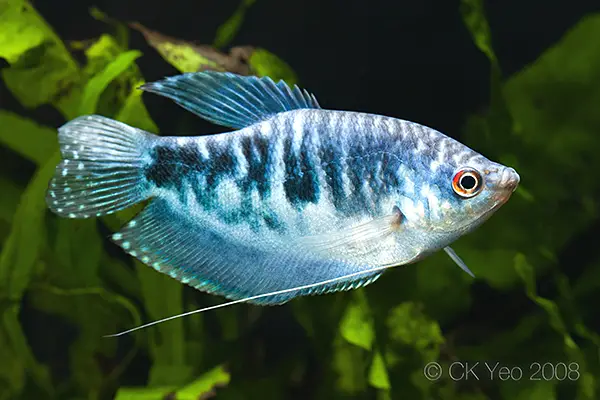
Different fish occupy different depths in the tank. Loricariidae and corydoras catfish, for example, prefer to be closer to the bottom, as do many species of barb. By comparison, stately gouramis prefer to occupy the area near the surface. Plenty of fish prefer the middle. The Law of Gradient is an adjunct to the Law of Shared Space that specifies the law most applies to cases where fish sharing an overlap in tank capacity occupy different depths. The design equivalent of the Law of Gradient is the Pesciphile Law of Thirds which states that an odd number of species should occupy each of the top, middle, and bottom depth slots.
T. Trichopterus var. "Opaline" - my first feature fish.

Step One: Feature Fish
A feature fish is a fish, often a single specimen, intended to be the focus of the tank. In many, but not all cases, it is a larger, visually-striking focal-fish, such as an angel, discus, or larger-species gourami. Feature fish are a common feature in increasingly-larger tank size categories because they catch the eye and bring attention in for the smaller fish that they cohabit.

Since the feature fish is often a favourite, almost always getting named, and frequently the focus of the owner's affection, I usually advise people to start selecting their tank stock based on that one feature fish. 

Step Two: Apply Bounds
My favourite tool for making stock lists is a digital spreadsheet (I use Microsoft Excel, to the chagrin of my linux/open-source circle of friends) - a template can be found here. The reason for that is that combining fish makes the acceptable water condition balance more and more specific with each new species you add. Essentially, the tank's pH and Hardness should be as close to the middle of the overlap of the range of all the fish as possible.

If you picture each range as overlapping lines, you want to be as close to the middle of the segment where every range overlaps as possible. In general, this is not difficult to do, though a few species will make it difficult.

Step Three: Introduction
I introduce fish according to size and numbers. I try never to introduce more than a half-dozen fish at a time to give the tank time to adjust to their bioload, and I start with the smallest first, which is more a matter of preference than anything. Always acclimate fish to your new tank conditions and always keep an eye on new fish for undue aggression or stress. I advise people who have the room to have a second tank available as a quarantine, and to introduce new fish only after the quarantine fish have been shown healthy for a few days. Where I work, we do a pretty good job of quarantining sick fish ourselves, but we're not always perfect, and an ounce of prevention is worth a pound of cure.

On Utility Fish
There are a few fish that seem doomed to be kept in inhospitable conditions - the loricarridae - specifically because they are known to eat awfuchs, the buildup of algae and biofilm on glass and tank contents that many consider unsightly. The Loricarids are particularly popular for this purpose, supposedly because they are among the only species to clean glass itself. Unfortunately, your average aquarist doesn't have the tank capacity to care for one of these fish properly, and so these fish wind up being stunted and die prematurely.
Ancistrus spp. The common Bristle-Nose

For those with very small tanks I recommend snails as the most effective and simplest-kept solution for cleaning glass. If you're anything like me, though, snails are about as boring as they come, breed too easily, and are too difficult to be rid of. If you absolutely must insist on using a fish in a smaller (sub-0 gallon) tank in the role of an "algae-eater", focus on Otocinculus spp. (the so-called "midget suckermouth catfishes") or Ancistrus spp. (the Bristle-Nose Plecos). These are fish that stay small naturally, eat awfuchs voraciously, and are much better suited to small tanks.

Establishing a Theme
When I go for a theme, I usually go for contrasting colours, though an increasingly popular (and, in my opinion, much nicer) trend is to build a biotope aquarium. A biotope as closely resembles the conditions of a given body of water as much as humanly possible - Amazonian is a popular example. Biotope tanks are a challenge, because sourcing aquatic plants endemic to a specific region is much harder than selecting fish. It is, however, considered rewarding by many.

In point of fact, I know of a few species of fish that can only be kept safely in conditions so specific as to force the owner to create a biotope tank for them. These are all very visually-interesting fish as well, and it's an option worth considering.

There Oughta be a Law

B. Splendens of a veil-tail trope. (c) Athena Slater
Bettas are easily the most abused species of freshwater pet.
Preventing animal abuse is one of those things everyone says they support whether they mean it or not. In that respect it's a lot like a few other issues I can name.

For some reason, at least in my experience, fish seem to be the most abused pets in the western world. It might have something to do with the fact that fish are relatively cheap, and they're perceived as a relatively easy pet. This unfortunate consequence of economics and perception has lead those who are passionate about the subject to shake their head and quietly mutter about the need for a law.

Now, I could go on and on about the different common abuses of fish I see or hear about on a day to day basis but that matter less than the story I actually came to tell.  As we all well know, thoughts are circular and so tangents are common, and very often the lesson in one field is imparted by an experience in a totally different field. But now I'm getting ahead of myself; let me tell the story.

One of my fellow fish and reptile experts is a guy with a real fondness for snakes, skinks, monitors, and arachnids but possessed of no real affection for fish. I can't say I blame him, as all of the pets I just mentioned are more interesting and the first two certainly more friendly than fish, but even then he knows a thing or two by virtue of having to work directly with fish. Now, he came to me today to ask me about a customer he had in the fish room a few days before. This person was looking for a plecostomus, which are the armoured catfish commonly called "algae eaters".

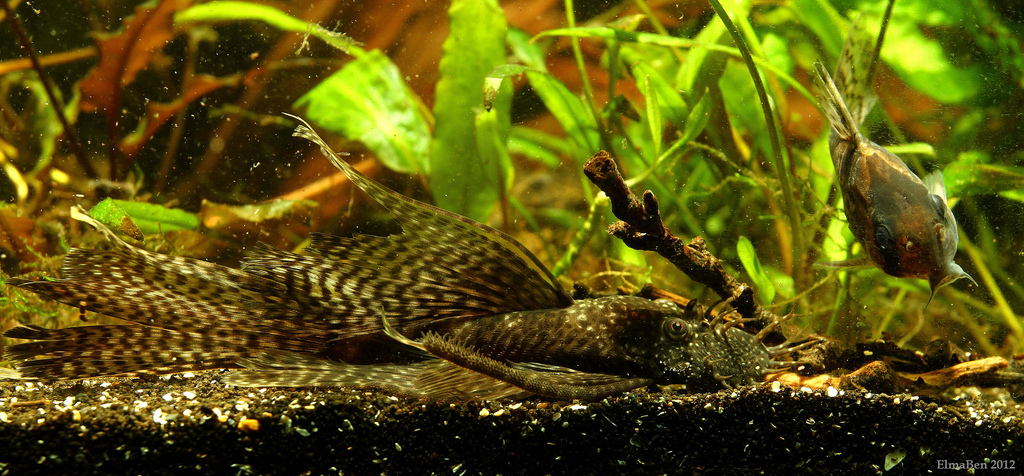
One of the many plecostomus loricariidae seen in the hobby.
Now, plecos are unfortunately the first most abused fish in the hobby after goldfish. They're usually ill-bred, and the ones unlucky enough not to get picked out by enthusiasts of their genus often get pressed into service as janitors in tanks too small, warm, cold, acidic, basic, or heavily stocked for them. As a result, many die prematurely. With the dwarf "bushynose" species being too new to the local hobby they are often ignored despite being better suited for the average aquarist's tank, which means that I'm constantly having to hunt down a sufficiently small pleco to face a slow and agonizing death-by-stunting because there's obviously no good reason to pay an extra two dollars for the right fish for the aquarium. There's no law against stunting fish, corporate has no problem with it because they consider the fish a step above feeder animals, and I have surprisingly little wiggle-room when it comes to telling people they cannot adopt a pet they're obviously not suited for.

The reason this particular customer stuck in my partner's mind (and mine, now), is that they asked for a pleco in this way:

"I want an algae eater. Give me the cheapest one possible because it's just going to die in two weeks anyway."

My coworker did the right thing - he followed up with questions about tank conditions, all of which should (in my opinion) proceed every fish sale, and all of which were met with assertions that the tank was perfectly fine (which it obviously couldn't be) and that the tank conditions weren't any of my co-worker's business.

In the end, as I recall, she wound up getting frustrated and didn't get her fish, but I'm certain she'll be back when someone less inclined to be troublesome isn't working, and likely wind up with another plecostomus.

All of this, however, sounds like another issue. See, my friends and I get mad about bad fishkeeping because it's an abuse. Most of the fish we carry are captive-bred, but there's always exceptions to the rule, and in either case, I can't think of a single species of fish that didn't at least have its roots in the wild. Even if that weren't the case, it would still be true that we as keepers owe these fish the best possible shot at a long, reasonably happy, and reasonably healthy life. After all, fish, perhaps moreso than any pet, experience a reality totally dictated by their owner.. An aquarist has the last word on every aspect of tank layout, water conditions, food availability, and tankmates. Even the feeder insects at work get better treatment than many of the fish I've seen in private aquaria. In this respect I'm no saint and I've been the unwitting abuser of plenty of fish in my day.

The point of realization, though, was that quiet shaking of the head, and the muttering of "there oughta be a law" that usually follows such encounters. Interestingly enough, the epiphany actually had nothing to do with animal abuse, though it did have to do with another form of human cruelty.

For those who missed it, I managed to wade hip-deep in the mirky soup of abortion debates (however briefly) over at Cam's blog. It's one of those sleek and sexy issues that seems attractive before someone's had their tea but which should have, frankly, been resolved well before I was born. As I recall it, I had expressed the idea that one can be personally opposed to abortion but still be in favour of its legality as a mechanism of personal choice.

Bear in mind that this is an extremely nuanced subject. We're dealing with layers and layers of consequences which must all be considered from every angle. The reason that I never seem to express a concrete position on it is that the subject is simply too complicated to encompass with a short-form answer. 

So far as it goes, though, I understant the pro-life argument quite a bit better standing over here. If I can get teed  up over people abusing fish, people being needlessly cruel to human fetuses should bother me too, I would expect.

The idea of where life begins is complex and varied. At the moment, I'm leaning toward conception. Ask me again tomorrow.

Monday, October 8, 2012

Introductory Fishkeeping: Tank Selection and Setup

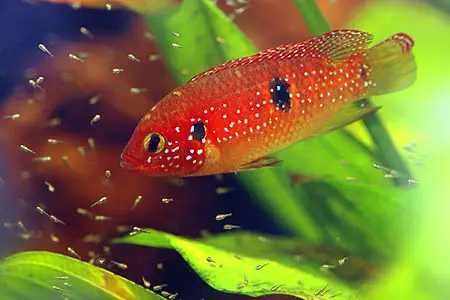
Jewel Cichlid Female (H. Bimaculatus) with Fry
SeriouslyFish.com photo
It occurred to me that even after running the Fish Cave blog for quite a while I've never actually gotten around to compiling a guide on taking care of fish. As it happens, taking care of fish is something of a passion of mine - one I don't mind doing for hours and hours on end. Of the various species it is possible to keep as pets, fish are possibly the most alien to our considerably powerful mammalian brains, and under the right care conditions, I've yet to find a fish in the hobby that wasn't gorgeous in some way, shape, or form. From the grace of a shoal of Dojo Loaches to the visual flattery of Discus, there are very few fishes that inspire a "bleh" reaction from me, and there's certainly the right fish out there for anyone.

Firstly, if you're reading this guide without having bought anything at all yet: great! Research, particularly when it comes to living things, is a great thing. Kudos to you. Hopefully this guide will help, just a little bit, in choosing your build and getting it going. In this article I take it as a given that we're discussing a freshwater, planted aquarium.

Size Matters
There are, frankly, three things to consider when selecting the size of the aquarium itself:

  • The Fish you're planning on keeping,
  • How well it will fit in the room, and,
  • Cycler's Law - larger tanks are chemically more stable than smaller ones.
If you already know what sort of fish you want, it's a good idea to check out sources like aquahobby.com or seriouslyfish.com in order to determine what they require in terms of water volume and tank base size. If you don't know, feel free to ignore that rule, but remember in general that a larger tank will leave more doors open in the future than a smaller one.

Tanks are More than Size
There's more to selecting a tank than what size they are. What sort of lighting are you going to need? Do you need a cover? What substrate should you use? What sort of filter will be best for your fish and your tank size?

The Filter: Your Tank's Beating Heart
Your filter is perhaps the single most important component of an aquarium after the glass itself. A proper filter is going to be circulating your tankwater, converting ammonia to safer compounds, adding motion to the water, and in many cases, oxygenating it. Whether you choose to go with a high-end canister filter or a hang-on-back variety, there are a few general tips I can give:
  • Always choose a Hagen product. Both the aquaclear HOB filter and the Fluval canisters are the most resilient  enduring, and practical filters I've ever worked with
  • Ditch activated carbon on the first media change. Seriously, whenever you finally have to change the filter media, replace your activated carbon package with foam media or a biological substrate like Biomax. I'll explain why in the following section.
  • Ensure that your tank size is within the limits of the filter you are choosing, and ensure that all intake and output passages are inaccessible to fish.
A canister is, by design, always more effective than the corresponding grade of Hang On Back filters, but for some well-behaved (read: low-waste) fish, an HOB is more than sufficient for all but the most diehard aquarist.

Concept: Nitrogen Cycle
If you're anything like me, your first thought after hearing the words "nitro-cycle" will be to remember the motorcycle-like penny farthing from Wild Wild West. Unfortunately, the real thing is invisible to the naked eye, but it should not be ignored. If the filter is the beating heart of the tank, than the nitrogen cycle is the circulation it drives.

As fish excrete waste, and as uneaten food and dead plants decay, they give off ammonia (a nitrogen compound), which is toxic to fish. In a properly "cycled" tank, bacteria called nitrosomona actually digest this ammonia and produce Nitrites. Nitrites are less toxic than ammonia, but still pose a risk to fish, and another bacteria, nitrospira, further digest the Nitrites into nitrates, which is (mostly) harmless to fish and actually serves as nutrients for the aquarium's plants. Nitrates do, however, continue to build up, but this problem is corrected with partial water changes.

This cycle can be encouraged with the use of a Nutrafin product called, unimaginatively, Cycle, which is little more than a cocktail of nitrosomona and nitrospira. Even still, establishing a nitrogen cycle takes time, as we will see below.

Lighting
An important part of choosing lighting is going to be staying within the bounds of what your canopy will support. Whether you have a simple light-bar or an actual enclosed tank-top, it's going to be set up for a certain length, type, and wattage of bulb. In general, I try to encourage people to stay away from incandescent bulbs and favor longer-lived (and more versatile) florescent ones... choose your canopy accordingly.

With the exception of some fish which prefer low-light, it's hard to overdo lighting, but it does take some tuning. You need to adjust for the level of plantation, particularly with the Plant-Gro bulb, because unused nutrients are almost always hanging around a tank and an unused amount of energy could result in an inadvertent algae bloom (which is also why we try to keep our tanks out of direct sunlight). These blooms are both ugly and potentially dangerous to fish, but easily averted and easily-enough corrected.

As it happens, I do maintain a few tanks in direct sunlight. I keep the algae level down using what's called a UV filter. The filter sucks water through and zaps it with high-energy UV, killing the algae, which then get eaten up by the proper filter. Between a Fluval canister and this UV filter, one tank under direct sunlight went from being an opaque green to being almost perfectly clear essentially overnight.

Substrate
Most of us are familiar with gravel-bottomed tanks. For many fish this is actually ideal as it prevents them from swallowing up substrate and becoming impacted, but for many other fish gravel is too rough and too large-grained for their purposes. Do your research on your fish, and don't be afraid to mix and match. Personally, I like sandy substrates with "islands" of natural-coloured gravel; I find it looks more natural.

Heating
Always make sure you have a heater rated for the tank size you are using. This should be sufficient to reach any temperature you need, comfortably, and such heating is essential for all but three species of fish that I can think of which are commonly available in the hobby.

Chemicals
As I mentioned in the section on the nitrogen cycle section, you're going to find that the most important parameters of your tank are all going to be absent of your senses and you'll need some help figuring them out and getting them working properly.

The first chemical we need to talk about is a water conditioner - I use AquaPlus - which is for dechlorination of water and usually does a few other things too, like neutralize heavy metals. As a general rule I dose this whenever I add water to a tank, add fish to a tank, or even when I seem to be having white clouds (which is an issue with phosphate content of the water). Early signs of disease? Give it a squirt. Packaging fish for a move? Bet your bottom dollar they get a dose.

We already talked about cycle - a good off-label use for that particular chemical is in attempting to clear up the afforementioned white cloudiness issue, before moving on to an actual phosphate remover. Since this usually works I almost never keep the latter at home and I rarely have to open it at work.

Next comes your test kit. The hard part is selecting one, since not every keeper needs every test, or needs it often enough to have it be part of the main kit rather than an addon. In this respect Hagen makes a very nice range of tests under the Nutrafin brand. At minimum, everyone should be able to test for pH, ammonia (NH3/NH4) and hardness (KH). If you're going to be wandering beyond Swords, Anubias, and Java Fern/Moss by way of planting, having tests for the other two nitrogen-cycle compounds as well as iron and phosphates isn't a bad idea. Test regularly and often. pH adjustment chemicals are encouraged but unnecessary to those with a fundamental understanding of chemistry and suitable caution. Keep the books around, too - some tests are more complicated than you would think, and even without that, you need the charts on the back of the book to reliably interpret the results.

The last chemical we need to talk about right now is salt. Believe it or not, even the freshest setups require a little aquarium salt, and many tropicals we consider to be "freshwater" are actually brackish and require a little marine salt. If you're working with the latter, you'll also need a hydrometer to measure the specific gravity of the water-marine solution.

Putting it All Together
Now that we have what we need, it's time to start putting together the tank. The first step will be to rinse everything in warm water to clear it of dust. At no time should you use surfactants like soap or detergent on anything going in your tank. Wash all components with warm water before construction and wash all decorations before adding them (any "found" decorations like rocks or driftwood should be vigorously boiled to sterilize them).

Assembly is going to vary according to specific parts, so in that respect I defer you to the manuals, with the strong caution not to add water until the tank is positioned exactly as you want it. Add room-temperature, conditioned water (and do so slowly in order to avoid disturbing your substrate and requiring you to wet-rescape). Allow the filter to run the water through overnight, which should eliminate the clouds caused by stirring everything up.

Now the waiting begins. A nitrogen cycle can take a few weeks to establish, during which you should still feed the empty tank. Watch the ammonia go up daily and wait for it to crash back down to zero. During this time, it's also possible to adjust the salinity and acidity of the water to suit the tastes of the fish you're considering. If you still aren't sure what fish you want, steer toward 7.0 pH, with as low a hardness (KH) as you can managed, at a temperature of 76-78 Fahrenheit. This is a "neutral" starting point for most species of tropical and a common set of water parameters for community tanks. Obviously, if you have fish picked out already, now's a good time to get the parameters down to what they like.

After the nitrogen crash, begin planting, which will start the nitrates being eaten up. It is now okay to begin slowly introducing fish to their new home. As a general rule I try never to add more than 10 "small" fish at once (such as tetras, livebearers, etc) and I usually count feature fish (sharks, discus, cichlids, large tetras, labyrinth fishes, and so forth) as two or three depending on their size.

Allowing the full time to elapse between first adding the water and establishing the nitrogen cycle should keep your fish as happy as possible and minimize your losses. Always remember that some pet salespeople are salespeople first and pet-keepers second, and that nobody knows every animal; cycle your tank. If someone tells you that a given fish could handle living through the cycle, remember two things: they might actually be right, and that's a bad thing.

You're more than a haver of fish. You're a fish-keeper, responsible for their wellbeing and longevity. I can't think of an aquarium fish with a captive life of less than three years and I can think of at least five species I know of that live longer than 20, in the proper conditions. Fish are alive, and just like how you would never abuse a dog or abuse a baby, you should never abuse a fish.